A high-converting furniture product configurator is one that loads instantly, responds to every touch without lag, shows materials and dimensions true to life, lets the shopper place the finished piece in their own room in augmented reality, and makes them feel like they built it. Get those things right and the configurator stops being a widget on the product page and becomes the thing that closes the sale.
Furniture is the hardest category in ecommerce to sell online, and the most rewarding to get right. The items are expensive, the decisions are considered, and the return rates are punishing. It’s also the category where a great configurator has the biggest measurable impact: furniture retailers using 3D and AR consistently report higher conversion, larger orders, and dramatically fewer returns. This article breaks down the anatomy of a furniture configurator that actually converts, component by component, and explains why some configurators drive millions in extra revenue while others just sit there looking nice.
Why furniture is the ultimate configurator category
Three things make furniture uniquely suited to configuration, and uniquely punishing when you get it wrong.
- The stakes are high. A sofa is a several-thousand-dollar, live-with-it-for-a-decade decision. Shoppers won’t commit until their doubts are resolved, and flat photos leave too many open.
- Returns are brutal. Furniture return rates run around 20–25%, and every return of a bulky, high-ticket item is enormously expensive to process. Most of those returns come down to three preventable causes: it didn’t fit, the color was wrong, or it didn’t match the room. A configurator paired with AR answers all three before the order is placed.
- The variation is real. A single sofa model can come in dozens of fabrics, several configurations, multiple leg finishes, and different sizes, easily tens of thousands of combinations, sometimes millions. No photographer can shoot them all. This is exactly the problem 3D configuration exists to solve.
That combination of high value, high returns and high variation is why furniture is where configurators earn their keep. Now let’s look at what actually makes one convert.
The anatomy of a high-converting furniture configurator
-
It loads before the shopper loses patience
Speed is the foundation everything else sits on. Furniture shoppers are overwhelmingly on mobile, and the patience window for an interactive product element is roughly two seconds before bounce rates climb. A configurator that spins a loading bar has already lost a share of buyers before they touch it, and it drags down the Core Web Vitals that affect both conversion and search ranking.
There are two architectural approaches to hitting that window, and it’s worth understanding the trade-off. One approach pre-renders every possible combination into images ahead of time and streams the right picture on demand, fast to paint, but it locks you to a finite, pre-baked set of combinations. The other renders the product in real time in the browser using WebGL, which keeps configuration genuinely open-ended and, done well, loads just as fast because modern platforms stream optimized, device-appropriate assets rather than dumping raw geometry on the device.
The point that matters: speed is non-negotiable, but you shouldn’t have to trade away genuine interactivity to get it. A well-engineered real-time configurator delivers both.
-
Every interaction responds instantly
Once loaded, the configurator lives or dies on its micro-interactions; the small moments of touch and response where the purchase decision actually crystallizes. The brain reads these signals as a proxy for product quality. A configurator that responds instantly feels like a well-made piece of furniture; one that lags feels cheap, and the shopper transfers that feeling to the product itself.
Three interactions matter most for furniture:
Rotation with weight. The product should turn with momentum and easing, like turning a heavy, well-balanced object in your hands; not a jittery turntable, and not so fast it blurs.
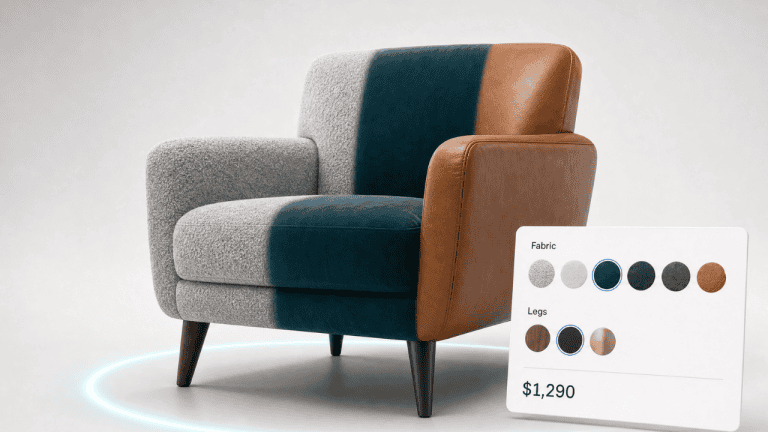
Instant material swaps. When a shopper taps a fabric swatch, the change should fire on touch-down, not after a beat, and the selected swatch should stay clearly marked. The gap between intent and result should feel invisible.
Zoom that lands on craftsmanship. Zoom should snap to the details that justify the price, the stitching, the seam of a cushion, the joint of a leg, the weave of the upholstery, not empty surface area.
Surface area that doesn’t respond, or responds late, reads as cheapness. Surface area that responds instantly reads as quality. In furniture, where the whole game is convincing someone a piece is worth the money, that perception is everything.
-
Materials and fabrics look true to life
Furniture is a tactile purchase, and material fidelity is where many configurators quietly fail. A “linen” that renders like plastic, a “walnut” that looks painted on, a leather with no grain, each one undermines trust at the exact moment you’re asking for it. For furniture specifically, the configurator has to render fabric weave, wood grain, metal finish, and how each catches light with enough realism that the shopper believes what they’re seeing.
This matters commercially because material is often the highest-margin choice a buyer makes. A shopper who trusts the premium-leather render is a shopper who’ll pay for it. A shopper who doubts it defaults to the safe, cheaper option, or leaves to go see it in a store.
-
It configures the combinations that actually matter
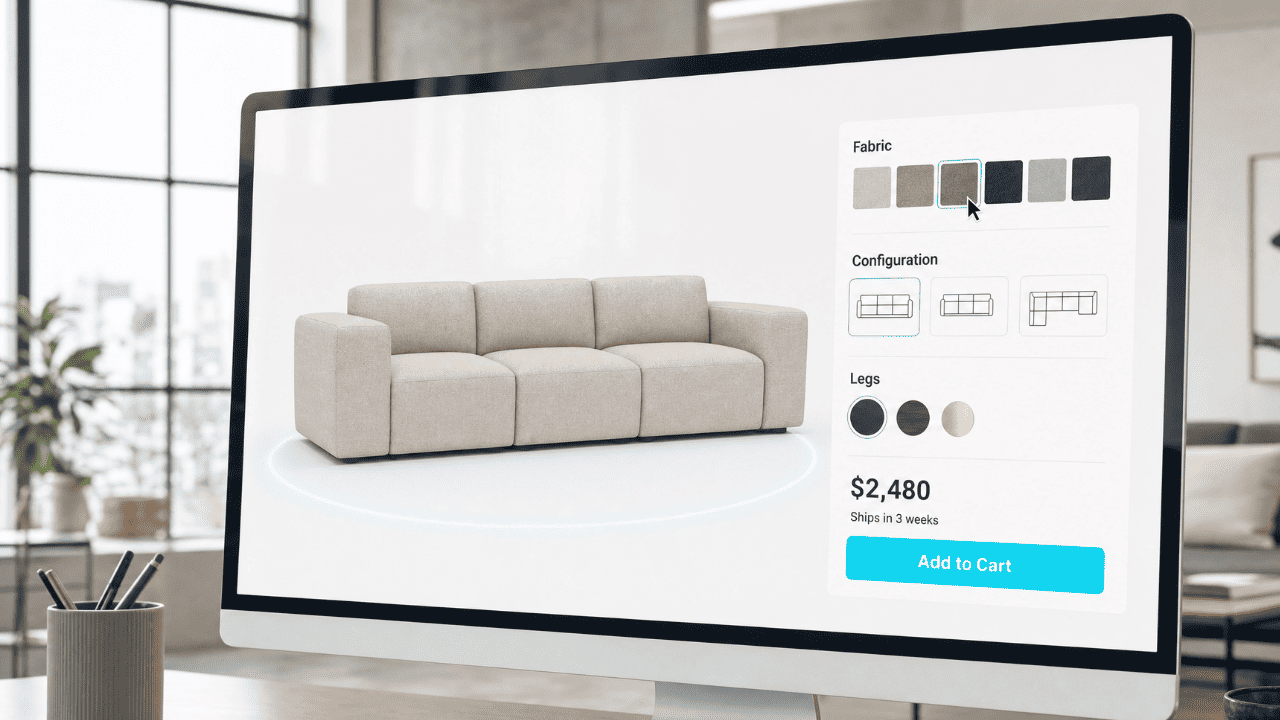
For furniture, the configuration itself has to handle the things furniture buyers really change: modular and sectional layouts, dimensions and sizing, cushion depth and fill, leg style and finish, and fabric across multiple zones. The best furniture configurators let a shopper assemble a sectional piece by piece and see it resolve in real time, not pick from a short list of pre-set bundles.
This is where a genuinely real-time approach pulls ahead of a pre-rendered image library. Pre-rendering works when the number of combinations is small and fixed. But a modular sofa system can run to millions of valid configurations, and no one pre-renders millions of images. Real-time 3D configuration handles that openness natively: the shopper builds any valid combination and sees it instantly, because the model is being rendered, not retrieved. For furniture’s genuinely large configuration spaces, that’s the difference between “pick a preset” and “build yours.”
A no-code rules engine sits behind this, making sure every combination the shopper can build is one you can actually manufacture and price, without a developer touching it each time you add a fabric.
-
It puts the finished piece in the shopper’s room
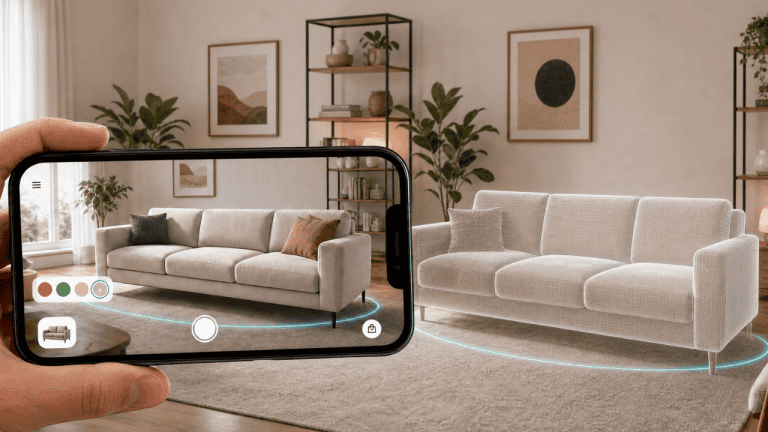
For furniture, web-based augmented reality isn’t a bonus feature bolted on at the end; it’s the single most important trust-builder in the whole experience, and it deserves to be treated as core. The number one furniture return reason is “it didn’t fit the space.” AR answers that directly: once a shopper has configured their piece, they place it in their actual living room, at true scale, through their phone camera with no app to download.
The impact is large and well-documented. Wayfair has reported that shoppers who use its AR features are far more likely to purchase than those who don’t, and across the industry two-thirds of shoppers say they’re less likely to return a product after using AR. When the sectional a shopper built is sitting against their real wall, in their own light, at real size, the abstract “I think this works” becomes “this works”, and the commitment becomes very hard to walk back.
Because Plattar’s configurator and AR run from the same real-time 3D model, the piece a shopper configures is the exact piece they place in their room. There’s no separate asset, no drop in fidelity between building and previewing. (See our guides to WebAR and AR for furniture retail.)
-
It triggers the endowment effect
Everything above sets up the psychology that actually closes furniture sales: the endowment effect, sometimes called the IKEA effect, the well-documented tendency to value something more highly when you helped create it. Stir the cake mix and the cake tastes better; pick the fabric, set the dimensions, choose the legs, and the sofa feels like yours before you’ve paid for it.
A configurator is a near-perfect machine for this. Every rotation, swap, and adjustment is an act of authorship. By the time a shopper reaches checkout, the piece on screen carries a psychological weight no static photo can produce, because they co-created it. This is why configurators lift not just conversion but average order value; buyers with a sense of ownership upgrade to better materials and add matching pieces. AR completes the loop: once the co-created piece is standing in their real room, the ownership becomes spatial, and the decision feels already made.
-
Your merchandising team can tune it without engineers
Here’s a component the shiny demos rarely mention but that separates configurators that keep converting from ones that decay: who can change them. The right setting for a sectional is not the right setting for a side chair: rotation speed, default view, zoom hotspots, and available options all differ by product. If every one of those adjustments needs a developer ticket, your catalog will never be tuned properly.
A no-code platform puts that control with the merchandising team that understands the products. They add the new season’s fabrics, set the hotspots on the parts that sell, and adjust defaults per product line, the same day, without engineering. Over a catalog of hundreds of SKUs, that operational reality is what determines whether the configurator’s conversion advantage is real or theoretical.
-
It’s wired seamlessly into the funnel
Finally, a high-converting configurator is invisibly connected to the business behind it. The configured piece has to carry through to the cart with the correct SKU, price, and full specification, on Shopify, WooCommerce, or a custom storefront, or into a quote for trade and contract buyers. Any friction between “I built it” and “I bought it” leaks the conversion the configurator just earned. (See how to add a configurator to Shopify.)
What the numbers say
The business case for getting the furniture configurator right is well-evidenced across the industry:
- Products with 3D/AR content convert at a 94% higher rate, per Shopify’s platform data.
- Furniture retailer CB2 reported product pages with 3D and AR drove around 21% higher revenue per visit and roughly a 13% larger order size.
- Wayfair has reported that AR users are dramatically more likely to purchase than non-AR shoppers.
- 3D and AR media can reduce returns by up to 40% (Shopify), and two-thirds of shoppers say they’re less likely to return after using AR (Snap/Publicis survey of 4,000+ shoppers).
- US shoppers returned roughly $849.9 billion of merchandise in 2025, for a bulky, high-ticket category like furniture, cutting returns falls straight to the bottom line.
The anatomy, in one checklist
A furniture configurator converts when it:
- Loads inside the ~2-second patience window on mobile, without sacrificing real interactivity
- Responds instantly to rotation, material swaps, and zoom
- Renders fabrics, woods, and finishes true to life
- Configures the combinations furniture buyers actually change: modular layouts, dimensions, finishes, in real time
- Lets shoppers place the finished piece in their room in WebAR, at true scale, with no app
- Triggers psychological ownership through genuine co-creation
- Can be tuned per product by the merchandising team, no developers required
- Carries the configured piece cleanly into the cart or quote
Miss the fundamentals and no amount of visual polish saves it. Get them right and, across a year of traffic on a high-value PDP, the gap between a great furniture configurator and an average one is measured in millions.
How Plattar approaches it
Plattar is a no-code 3D and WebAR platform built to deliver exactly this anatomy for furniture brands and retailers. Configuration and augmented reality run from the same real-time 3D model, so the piece a shopper builds is the piece they place in their room, no fidelity gap, no separate asset pipeline.
Your merchandising team manages materials, options, rules, and per-product settings without engineering, and the configured product wires straight into your existing storefront. The result is the full loop that converts furniture buyers: build it, see it true to life, stand it in your own room, own it.
Want to see it with a product like yours? Book a demo or explore Plattar’s furniture configurator examples.
Frequently asked questions
What makes a furniture product configurator high-converting?
A high-converting furniture configurator loads fast on mobile, responds instantly to every interaction, renders materials true to life, lets shoppers configure real combinations (modular layouts, dimensions, finishes) in real time, and lets them place the finished piece in their room in AR. Together these build the trust and psychological ownership that close high-ticket furniture sales.
Why is a configurator especially valuable for furniture?
Furniture is high-value, high-variation, and high-return. Configurators paired with AR resolve the exact doubts that drive furniture returns, fit, color, and match to the room, before the order is placed, which lifts conversion and average order value while cutting returns.
Do furniture configurators reduce returns?
Yes. Because shoppers see an accurate, to-scale version of exactly what they configured, including in their own room via AR, expectations match reality. Industry data shows 3D and AR can reduce returns by up to 40%, and two-thirds of shoppers are less likely to return after using AR.
Is real-time 3D or pre-rendered imagery better for a furniture configurator?
Both can load fast. The difference shows up with large configuration spaces: pre-rendering suits a small, fixed set of combinations, while real-time 3D handles the millions of valid combinations a modular furniture system can produce, and drives true-to-scale AR from the same model. For genuinely configurable furniture, real-time 3D is the more flexible foundation.
Does a furniture configurator need an app?
No. Modern configurators and their AR run in the web browser (WebAR), so shoppers configure and place products in their room directly from your product page with nothing to download.
Can my team manage the configurator without developers?
With a no-code platform like Plattar, yes. Merchandising teams add materials, set options and rules, and tune each product’s settings themselves, which is what keeps a large catalog converting over time.
What results do furniture brands see from configurators and AR? Reported results include markedly higher conversion, larger average orders (CB2 saw around 21% higher revenue per visit and a 13% larger order size), and substantially fewer returns.
See the full build-it, see-it, own-it loop with your own products — book a demo or read our complete guide to 3D product configurators.
We'll build you a bespoke demo around your own website and your own range, and answer any of the questions in this post.
Request a Demo